
Application Guide · 2026
UV Laser Cutting Seashell:
What It Does, How It Works,
and Who It’s For
·
6 min read
·
UV Laser · Seashell · B2B
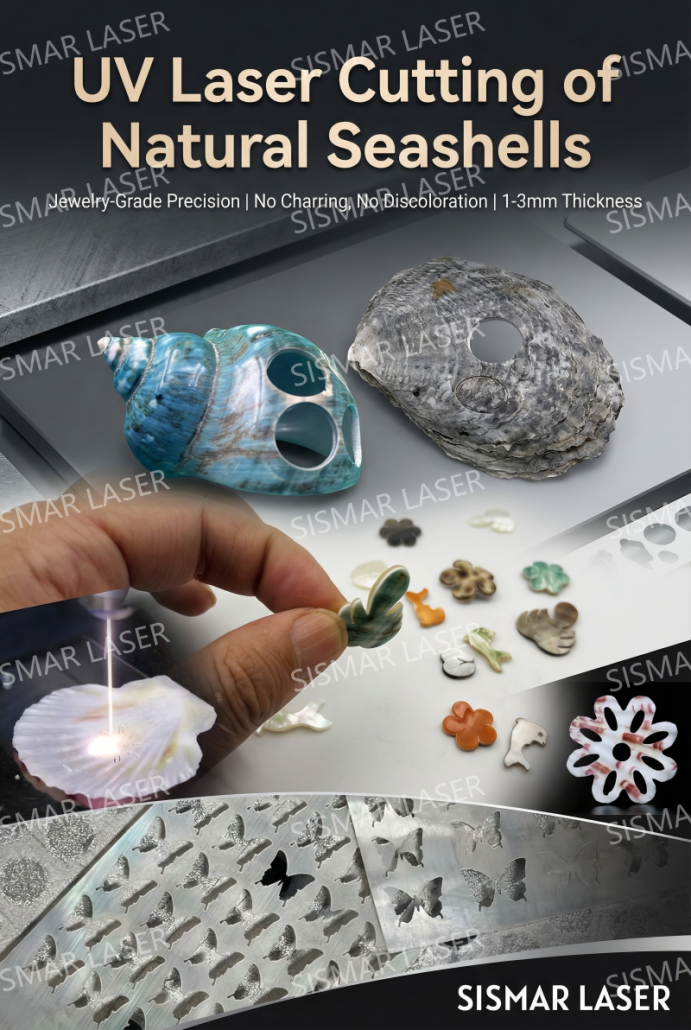
Natural seashell is brittle, layered, and heat-sensitive. Traditional cutting methods crack it. Mechanical tools wear through the surface grain. UV laser cutting solves both problems — and this article explains exactly how.
Why seashell is difficult to cut
Seashell consists of calcium carbonate layers bound by organic proteins. That structure gives it visual appeal — iridescent nacre, natural colour gradients — but makes it fragile under mechanical stress and thermal exposure. Sawing causes micro-fractures along grain lines. CO₂ laser cutting generates enough heat to yellow the surface or cause delamination.
UV laser cutting uses a 355 nm wavelength, which interacts with material through a photochemical process rather than thermal ablation. The material breaks molecular bonds directly, with minimal heat transfer to surrounding areas. The result: clean, precise edges on a material that normally resists precision processing.
Key parameters for UV laser cutting of seashell
Exact parameters depend on shell thickness, surface coating, and the complexity of the cut path. Thinner shells (under 1.5 mm) cut well at lower power settings. Thicker or denser specimens benefit from multiple passes rather than a single high-power run, which preserves edge quality.
UV vs CO₂ laser on shell material
- — Thermal-based cutting
- — Risk of yellowing / burning
- — Wider heat-affected zone
- — Less suited to thin shell
- — Lower equipment cost
- — Cold-light processing
- — Clean edge, no discolouration
- — Minimal heat-affected zone
- — Handles thin / brittle shell
- — Stable for batch production
For applications where edge quality and surface integrity matter — particularly jewellery and decorative accessories — UV laser is the correct choice. CO₂ remains suitable for rougher cutting tasks where cosmetic precision is not required.
Applicable industries and use cases
Most active users are small-to-medium jewellery manufacturers and craft processing workshops. OEM factories handling mixed natural material orders also use UV laser systems as part of a wider material processing line.
Production considerations
UV laser cutting of seashell is well-suited to batch production. Once a cutting file is established, repeatability is high. The main variables to control are material flatness (shell can warp if stored incorrectly) and focus height, which affects edge quality more than power does.
For factories running mixed jobs — cutting shell alongside acrylic, PCB material, or glass — a UV system handles all of these without tooling changes. This makes it a practical choice for contract manufacturers processing multiple brittle or heat-sensitive materials on a single production line.
Common questions
Enquiries & distribution
For technical specifications, sample testing, or regional distribution partnerships — contact the Sismar Laser team directly.
- 🌐 www.sismarlaser.com
- ✉️ Sales@sismarlaser.com
- 💬 WhatsApp: +86 138 5410 5019
- 📞 Cell: +86 186 1551 5768