
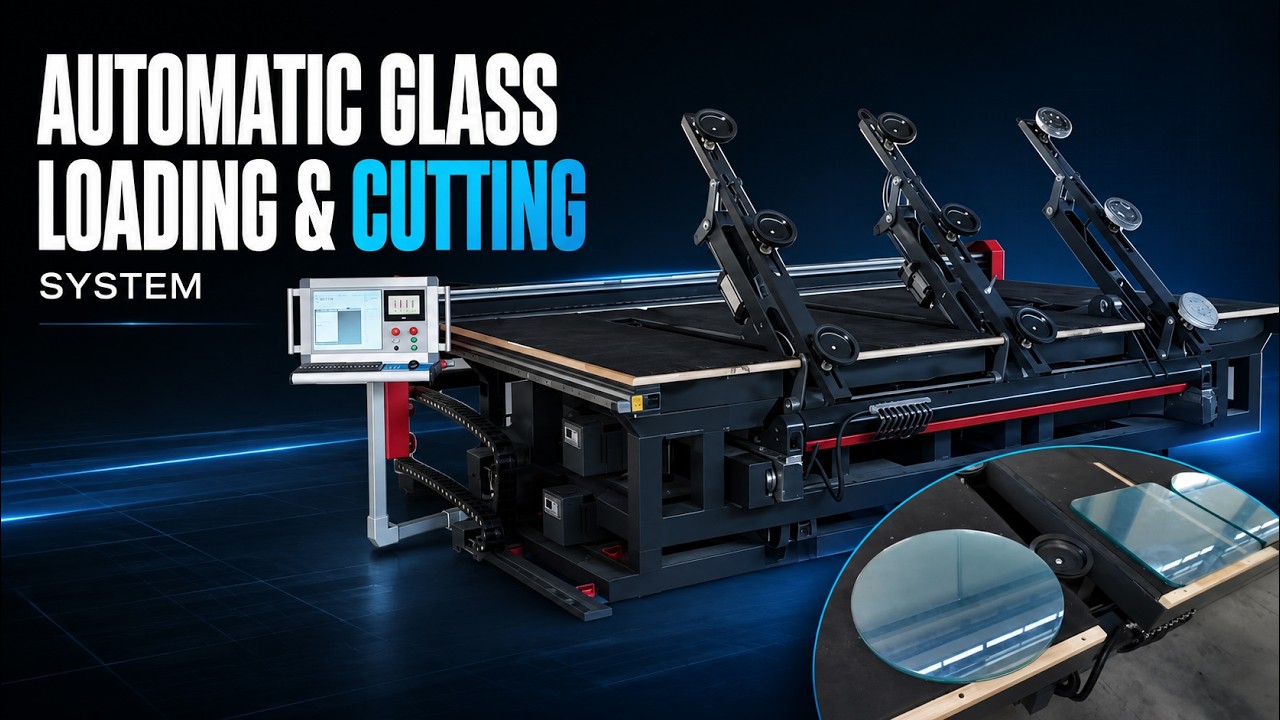
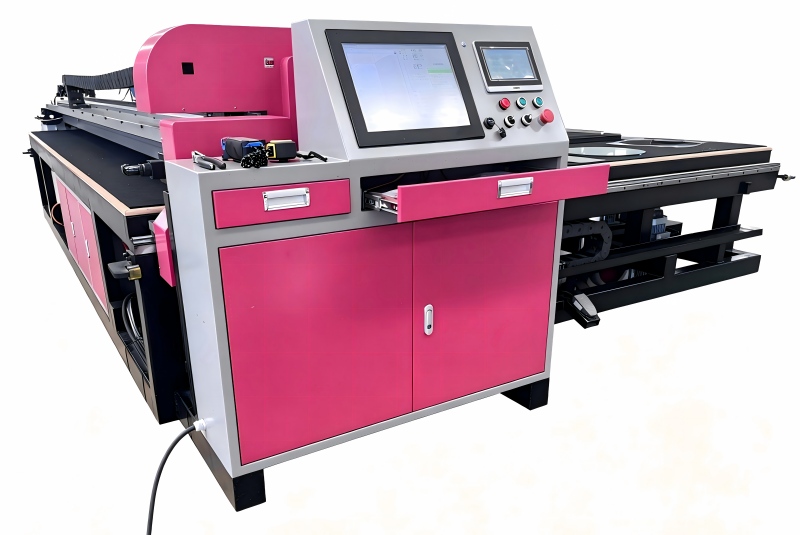
SL-AG3325 Automatic Glass Loading & Cutting Machine
For factories that process raw glass sheets before tempering, IGU assembly or mirror coating — loading and cutting now run on the same machine.
In many glass workshops, loading and cutting are handled as two separate steps. The glass sheet is moved from the rack to the cutting table, aligned, optimized and then cut. The SL-AG3325 brings these steps together on one machine: it moves to the rack, loads the sheet with its suction arms, transfers it to the table, detects the actual edge position, applies the Optima nesting layout, and completes straight or shaped cutting.
For factories cutting raw sheets ahead of tempering, insulating glass production, mirror processing, or door and window fabrication, that means less manual handling between stations and one less machine footprint to plan around.
Why Choose an Integrated Machine
Two stations become one
If loading and cutting are still running as two separate stations on your floor, here's how that changes with the SL-AG3325 on one table.
Traditional Workflow
Manual loading + separate cutting table
- More manual glass handling before cutting
- Larger floor space for two separate machines
- Time lost moving glass between stations
- Positioning can drift during the handling in between
- Harder to justify for small and medium workshops
SL-AG3325 Integrated Workflow
Automatic loading + positioning + CNC cutting, one machine
- Automatic loading helps reduce manual lifting onto the table
- One machine footprint instead of two
- No transfer step: the sheet loads and gets cut on the same table
- Automatic edge detection catches any positioning drift before the cut
How It Works
From the glass rack to a finished, separated sheet
Six steps, one machine — no running back and forth between two separate setups.
Move to the Glass Rack
The operator moves the machine to the glass rack with a handheld remote, so the machine can work closer to the glass storage area.
Automatic Glass Loading
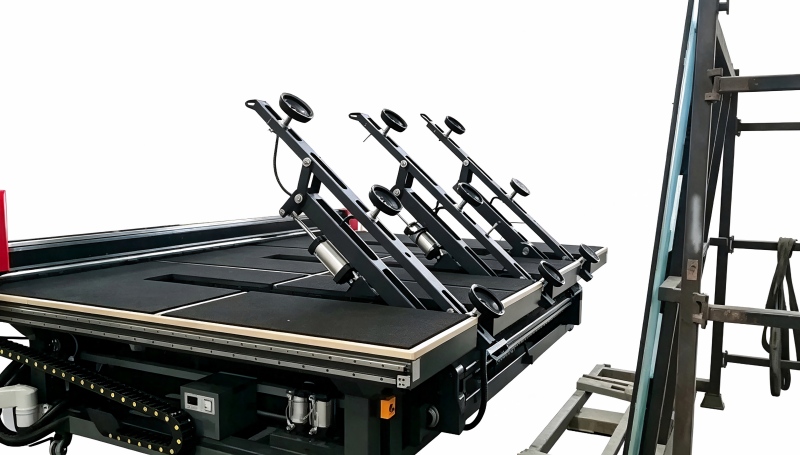
Three arms reach out, nine suction cups lock onto the sheet, and it lifts straight onto the cutting table — reducing manual lifting and carrying.
Edge Detection & Positioning
The machine checks exactly where the sheet landed — not where it's supposed to be — and adjusts the cut to match, reducing manual re-alignment before cutting.
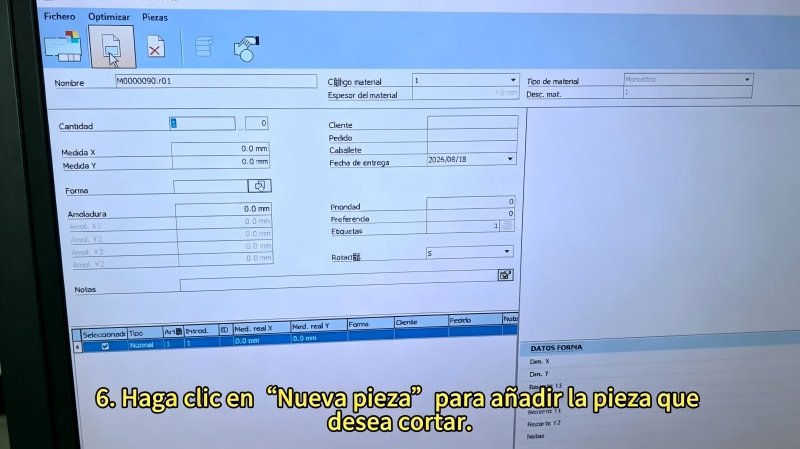
Nesting Optimization
Optima works out the best layout for the pieces in the order, so less good glass ends up as offcut.
CNC Glass Cutting
Bridge and head follow that layout — straight lines or shaped cuts, same pass, no re-setup in between.
Air Flotation & Assisted Breaking
The air table helps the operator move and turn the sheet. Breaking bars assist straight-line separation, while shaped or irregular pieces are separated by hand.
Key Functions
What's actually doing the work
The loading, movement, positioning, cutting and air flotation systems are designed to work together, helping the sheet move through the main cutting process with less handling.
Automatic Loading System
Three telescopic loading arms, three suction cup groups per arm — nine groups total. Single-side loading, so the machine only needs access from one side of the rack.
Mobile Loading, Stable Cutting
Remote-controlled movement gets the machine to the glass rack and back. Once it's in position, bottom support cylinders lock the machine body down. Mobile for loading, stable for cutting.
Edge Detection & Shape Scanning
The system reads the glass sheet's real position and angle and corrects the cutting path automatically. For irregular pieces or templates, the shape scanner traces the outline and cuts to match it.
Optima Nesting & CNC Cutting
Optima optimizes the layout before the cut; the machine then runs straight or shaped cuts against that layout.
Cutting oil supply is PLC-controlled and synchronized with the cutting head during the cutting process.Air Flotation & Assisted Breaking
The air cushion table makes it easier for the operator to move and turn the sheet after cutting. Breaking bars assist straight-line separation; shaped or irregular glass is still separated by hand.
Optional
Automatic Labeling System
The SL-AG3325 can be equipped with an automatic labeling system when production requires piece-by-piece tracking. After cutting, the printer generates a label with the glass information and the labeling unit applies it to the corresponding piece, reducing the manual labeling step before the next process.
For a shop running a few simple orders, you probably don't need this. But once you're cutting many sizes, many batches, or daily IGU and door/window orders, keeping track of which piece is which becomes a real problem — that's when labeling earns its cost.
Worth adding if you run:
- Insulating glass production
- Door and window glass, multiple sizes per batch
- High order volume, many batches per day
- Smart mirror or mirror processing
- Multiple customers' orders running through the shop at the same time
Applications
Who this machine is built for
The SL-AG3325 cuts raw glass sheets — before tempering, before IGU assembly, before mirror coating. It's not a machine for cutting already-tempered or already-processed glass.
Architectural Glass
Raw sheet cutting for building and façade glass projects.
Door & Window Glass
Multiple sizes per day for door and window fabrication.
Mirror & Smart Mirror Glass
Sheet cutting before mirror coating or smart-mirror assembly.
Glass Sheets for IGU Production
Optimized raw-sheet cutting before washing, spacer assembly and sealing.
General Glass Processing Factories
Workshops running mixed orders — different sizes, different shapes, every day.
Components & Technical Specifications
Built for Daily Glass Cutting Work
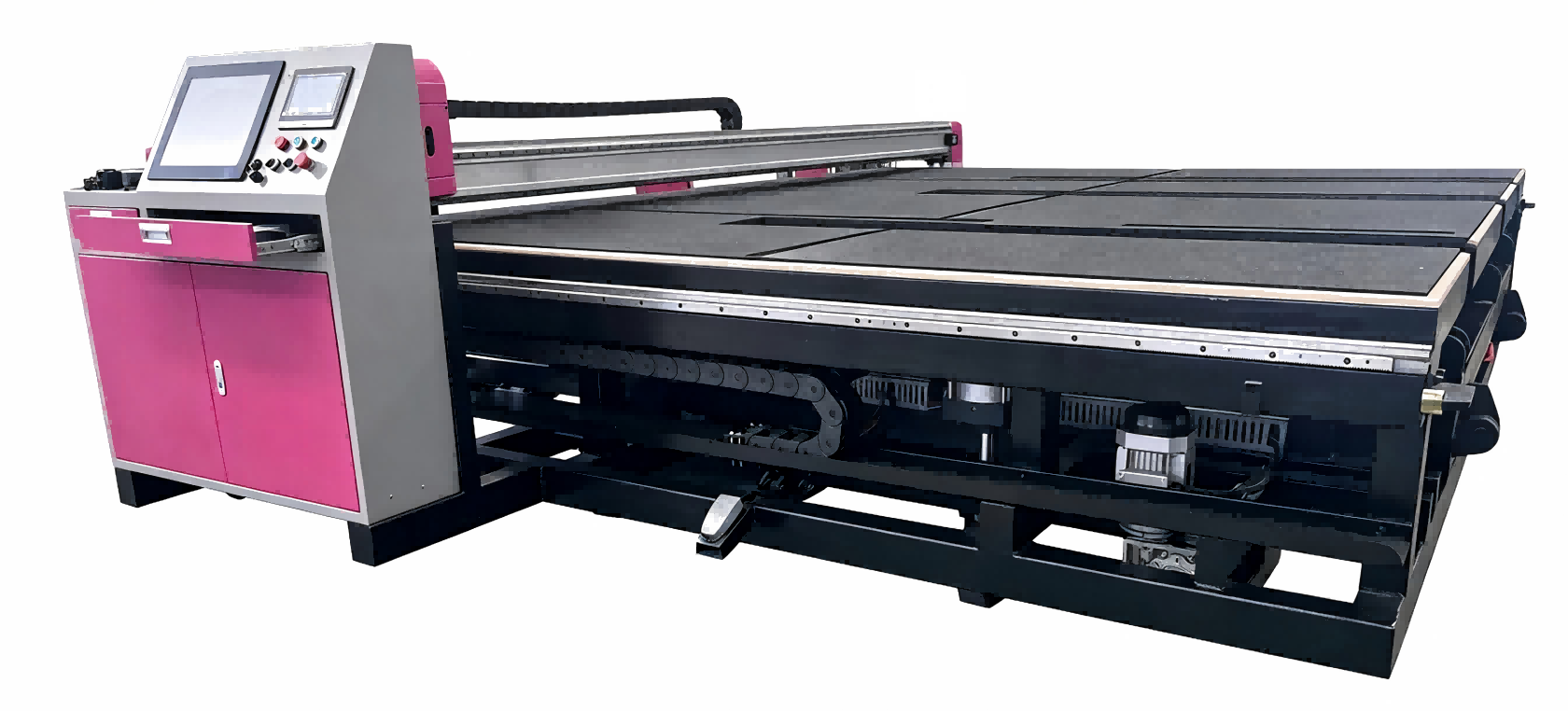
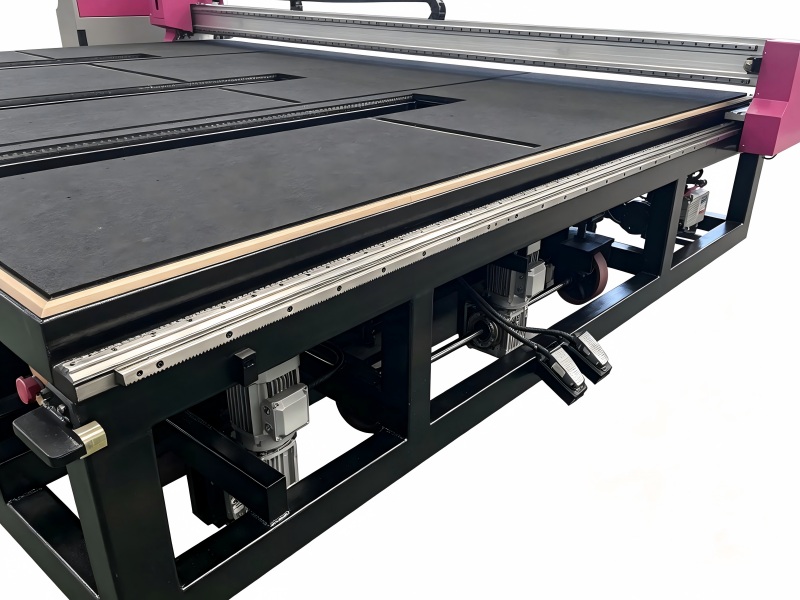
The SL-AG3325 uses selected mechanical, electrical and pneumatic components to support stable loading, smooth bridge movement and reliable CNC glass cutting in daily production.
Mechanical Structure
- Thick welded steel frame with aging treatment
- Machined side beam mounting surface
- Industrial steel cutting bridge structure
- HIWIN linear guide rails
- Ground helical rack and pinion transmission
- 25 mm PVC table board, industrial felt surface
- Imported nitrile rubber double-layer suction cups
- 3 kW high-pressure air flotation blower
- Vacuum pump for fast suction and stable negative pressure
Control & Electrical
- Panasonic PLC
- XINJE high-brightness TFT touch screen
- CHINT electrical components
- SMC high-precision proportional pressure valve
- AIRTAC pneumatic components, pressure valve, solenoid valve, oil mist separator, vacuum filter
- Bohle cutting wheel
- Optima nesting software
Technical Specifications
| Model | SL-AG3325 |
|---|---|
| Glass & Loading | |
| Maximum glass size | 3300 × 2440 mm |
| Glass thickness | 2–19 mm |
| Supported glass types | Float glass, Low-E glass, mirror glass, extra clear glass, raw sheets for IGU production |
| Loading method | Single-side automatic loading, 3 telescopic arms, 9 suction cup groups |
| Cutting & Positioning | |
| Cutting type | Straight cutting and shaped cutting |
| Positioning | Automatic edge detection and positioning |
| Shape scanning | Intelligent shape scanning for copy-shape cutting |
| Nesting software | Optima, standard |
| Cutting head / bridge speed | 0–200 m/min, adjustable |
| Machine & Power | |
| Air flotation / breaking bars | Standard |
| Automatic cutting oil supply | Standard |
| Automatic labeling | Optional |
| Machine movement | Remote-controlled movement and turning, bottom support cylinders for cutting stability |
| Power supply | 380V / 50Hz or 60Hz / 3-phase |
| Machine dimensions | 4000 × 3000 × 1500 mm |
FAQ
What buyers usually ask
Five questions buyers usually raise before requesting a quote.
What types of glass can the SL-AG3325 cut?
Can this machine cut tempered glass?
Is automatic labeling included?
Does the machine break the glass automatically?
Does the machine support shaped glass cutting?
Request a Quote
Tell Us Your Glass Cutting Requirements
Send your glass size, thickness and production volume — we'll recommend the right configuration and quote it.