Fiber Laser Marking Machine for Steel Strip Production Lines
Permanent Marking Directly on Your Production Line
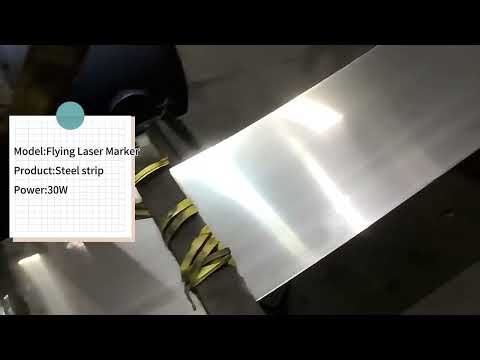
Mark batch numbers, coil IDs, barcodes, QR codes and MES/ERP-linked production data directly onto moving steel strip — at up to 200 m/min, without stopping the line.
Inkjet smears under mill-floor oil and wears off in handling; stamping locks you into one fixed design. A fiber laser mark is engraved into the surface itself, so it stays legible through everything the strip goes through next.
Available in 50W, 60W and 100W — send us your strip and target line speed, and we’ll test it in our factory and recommend the right setup before you quote anything.
A Mark That Survives the Line — and Everything After It
High-contrast marking that doesn’t wear off
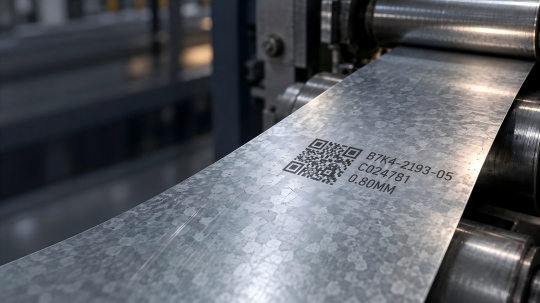
Steel strip goes through a lot after it’s marked — handling, stacking, galvanizing lines, outdoor storage, oil and coolant, the customer’s own downstream processing. Inkjet codes blur under abrasion, break down with oil and chemicals, and fade outdoors. Our fiber laser (1064nm) engraves into the surface itself, so batch IDs, coil numbers and QR codes stay legible through everything the strip goes through afterward.
- Resistant to abrasion, heat, corrosion and oil. Depending on material and surface finish, line width down to ≤0.01mm and characters as small as 0.15mm, so batch codes and QR codes stay sharp and scannable even at small size.
- Less to manage on the line. No ink to refill, no dies to change between jobs — update the batch or serial number from your MES record, and the machine marks it automatically.
Galvanized coating, stainless finish and bare steel all take a mark differently — that’s exactly what the free sample test is for. Send your strip along with your target line speed; we’ll mark it under the laser, send the sample back, and you’ll see the actual result before you commit to a power level.
Built to Work With Your Production Line
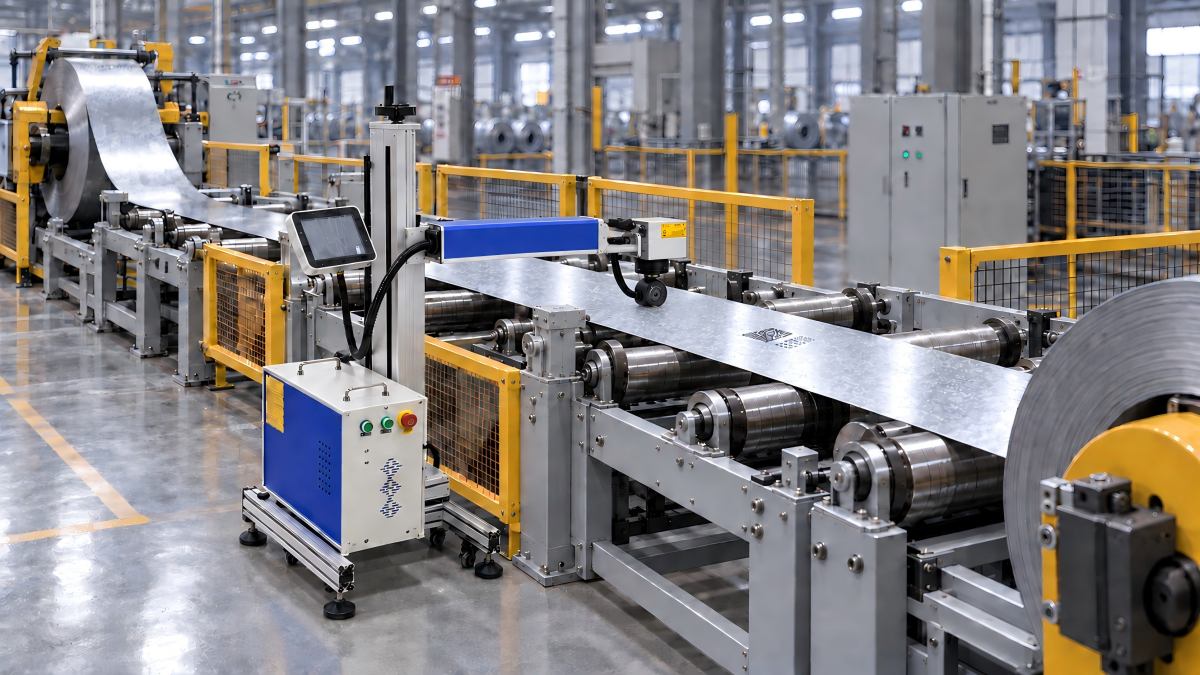
The system marks on the fly as strip moves through — it doesn’t need the line to stop. Sensors and encoder signals sync marking to your line’s actual speed.
The fiber marking station installs directly in line, between your existing processes — strip passes through without a separate stop-and-mark step.
Sensor & Encoder Synchronization
Sensors detect the strip as it passes; marking is triggered on the fly, synced to line speed without stopping production.
PLC, MES & ERP Integration
Modbus TCP/IP, Profinet and EtherCAT connect the machine to your line’s control system and MES/ERP — batch numbers, serial numbers and other variable data update automatically, pulled straight from your production records.
Traceability Content
Text, batch codes, serial numbers, barcodes, QR codes and logos — all markable as variable data that updates automatically run to run.
50W, 60W or 100W Fiber
Same machine, three power options. Which one fits your line depends on your line speed, steel grade and surface condition, marking size, and how much contrast or QR-code readability you need — exactly what the sample test is for.
Suits slower lines and smaller marking areas, where marking time isn’t the limiting factor.
For lines that need more speed margin than 50W offers, while keeping codes clear and high-contrast.
For high-throughput lines, larger marking fields, or marks that need to stay sharp within a shorter marking window.
Not sure which one fits? Send us your strip sample, target line speed and the content you need to mark — we’ll test it and confirm the right power before quotation.
Check the Numbers
Technical Specifications
| Parameter | Value |
|---|---|
| Laser Type | Fiber |
| Wavelength | 1064 nm |
| Power Options | 50W / 60W / 100W |
| Marking Method | On-the-fly continuous marking |
| Maximum Speed | Up to 200 m/min* |
| Marking Field | 110×110mm scan lens (customizable) |
| Minimum Line Width | ≤0.01mm |
| Minimum Character Size | 0.15mm |
| Lifetime | >100,000 hours MTBF |
| Power Consumption | <800W |
| Cooling | Air-cooled |
| Protection Rating | IP54 |
| Operating Temperature | 0–45°C |
| Communication | Modbus TCP/IP / Profinet / EtherCAT (PLC & MES/ERP integration) |
| Compliance | CE, FDA compliant |
*200 m/min is what’s been measured on the standard setup. Your actual speed depends on marking content, character height, number of lines, and repeat spacing — tell us your line speed and what you want marked, and we’ll confirm the real cycle time before you commit.
Fiber Laser vs. Inkjet & Stamping
| Fiber Laser | Inkjet | Stamping / Embossing | |
|---|---|---|---|
| Consumables | None | Ink, solvent, regular refills | Dies, plates |
| Variable data (batch, serial, QR) | Yes | Yes | No, mostly fixed content |
| Contact with strip | Non-contact | Non-contact | Contact |
| Mark durability | Resistant to abrasion, heat, corrosion and oil — confirmed by testing your material | Can blur or fade under abrasion, chemicals or UV | Durable but limited to fixed designs |
| What you’re maintaining | Optics, occasional cleaning | Ink system, nozzles, filters | Dies, plates, press |
| Typical strength | No consumables, permanent, high contrast | Mature, flexible inline printing | Low cost per unit on simple fixed designs |
If you’re running inkjet and it’s working, there’s no reason to switch. Fiber laser tends to make more sense once the mark has to survive what happens after marking — abrasion, oil, outdoor storage, downstream handling. Send us your strip sample, the content you need marked and your target line speed — we’ll test it on your actual material and show you whether fiber laser is a real improvement over what you’re running now.
Built for These Production Lines
Steel Strips & Coils
Batch numbers and QR codes marked directly on the strip for supply-chain traceability.
Galvanized Sheets
Coating grade, batch numbers and specs marked directly onto galvanized coil and sheet lines.
Stainless Steel Plates
Batch numbers, grade and QR codes marked with a mark that holds up through further processing and handling.
Automotive Materials
Component and batch identification for automotive-grade steel.
Building & Construction Steel
Specifications marked directly onto structural and construction steel.
Supply Chain Identification
Serial numbers and barcodes for tracking steel through the supply chain.
Questions We Get Asked
What is this fiber laser marking system?
A fiber laser marking machine built for continuous steel strip production lines — it marks the strip directly, in line, while it moves.
How fast can it mark?
Up to 200 m/min on the standard setup. What you’ll actually get depends on how much content you’re marking and how tight the repeat spacing is. Tell us your line speed and content, we’ll confirm the real number before you buy anything.
What content can it mark?
Text, batch and serial numbers, barcodes, QR codes, logos, and variable data linked straight from your MES or ERP system.
Is the marking permanent?
Yes — it’s engraved into the surface, not printed on top, so it’s resistant to abrasion, heat, corrosion and oil.
Does it need ink or other consumables?
No. It’s pure laser marking — no ink, no solvent, nothing to keep buying.
How reliable is the system?
The fiber laser source is rated for over 100,000 hours of continuous industrial use.
Will it integrate with our existing line?
Yes — Modbus TCP/IP, Profinet and EtherCAT connect it to your PLC, and it can pull variable data straight from your MES or ERP system.
What’s the advantage over inkjet or stamping?
Higher speed, a permanent mark, and no consumables to keep buying — inkjet blurs under abrasion and stamping locks you into fixed designs.
What industries use this?
Steel coil and strip producers, galvanizing and stainless lines, automotive component makers, and construction steel suppliers — anywhere batch or traceability data needs to survive further processing.
How can I test it on my material?
Send us a sample of your steel strip and your target line speed. We’ll test it under the laser ourselves and recommend the right power and setup before you commit to anything.
Ready to see it on your material?
Send us your strip sample, spec, or line speed — we’ll test it and recommend the right power and setup.